














NEWS
MIXI Releases Proprietary Model That Demonstrates Connection Between Human Capital Investment and Corporate Value Creation
MIXI begins measuring the effectiveness of human capital investments through its Human Capital Management Logic Model
Tokyo, Japan, June 19, 2026 — MIXI, Inc. announces that it has expanded its human capital disclosures in its 27th Annual Securities Report disclosed today, and has revealed its Human Capital Management Logic Model that demonstrates the connection between human capital investment and corporate value creation.
Details of the human capital disclosures can be found below:
・27th Annual Securities Report
https://pdf.irpocket.com/C2121/uOn6/a3ac/ysrU.pdf
■ The Human Capital Management Logic Model
This model uniquely defines how investments in human capital translate into business outcomes and ultimately lead to economic value (financial results).
Specifically, through investments in the four key areas of Talent Acquisition & Compensation, Development & Talent Management, Maximizing Organizational Capability, and Environment Creation, we aim to cultivate individuals who embody our Values (Innovation, Passion, and Integrity) and teams that continue to create value together, as outlined in our HR Policy. For new businesses, we measure the number of businesses created, while for existing businesses we focus on maintaining and improving profitability. Ultimately, we will drive our HR strategy based on the logic that these business outcomes lead to economic value (financial results) such as EBITDA per employee and Human Capital ROI.
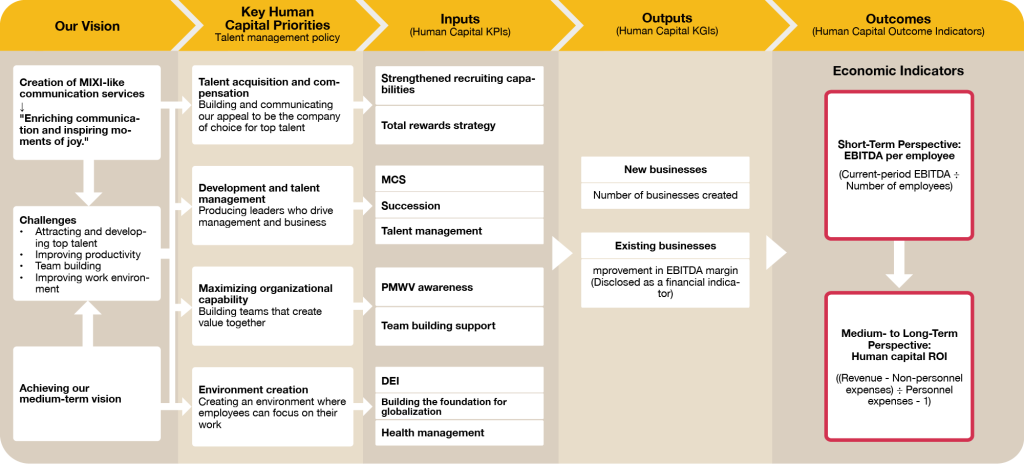
■ Reason for These Initiatives
We aim to be a company that continuously creates multiple communication services that create truly meaningful connections. To achieve this, we position human capital as a vital asset supporting our medium- to long-term corporate value and aggressively invest in it. Quantitatively visualizing the link between human capital investment, business outcomes, and economic value (financial results) is known to be a complex challenge. This is a particularly complex issue in businesses where headcount and utilization rates do not scale proportionally with business outcomes.
With growing social interest in human capital, we have positioned human capital management as a key management priority. Our management and HR sections held extensive discussions that led to building this model. By visualizing the connection between human capital investment, business outcomes, and economic value (financial results), we aim to align our business and HR strategies, ensuring the ongoing effectiveness of our human capital investments.
■ Key Indicators
To continuously evaluate the outcomes of our human capital investments from both business and economic (financial) perspectives, we have established the following indicators.
*All figures below represent the actual results and targets for MIXI, Inc. on a non-consolidated basis. We are progressively reviewing our strategic policies for the entire Group, with the long-term goal of establishing and disclosing these indicators on a consolidated basis.
Human Capital Outcome Indicators
These indicators measure whether investments in human capital ultimately translate into economic value (financial results). Based on the philosophy of treating talent as capital rather than a cost and maximizing its return, we have set targets that encourage continuous improvement beyond previously achieved levels, aiming to maintain and elevate these standards over the medium to long term. The target values have been aligned with the Medium-Term Vision announced in our FY2026/3 Full-Year Financial Results Presentation.
Details of the Medium-Term Vision can be found below.
・FY2026 Earnings Results Briefing Session
https://pdf.irpocket.com/C2121/WUpy/yN7i/zFUW.pdf
| Indicator | FY2026 Result | Medium-Term Target* | Notes |
|
EBITDA per Employee |
18.1 million yen |
25.0 million yen |
EBITDA ÷ Number of employees |
|
Human Capital ROI |
162.4% | 200.0% | ((Operating Income + Personnel Expenses) ÷ Personnel Expenses – 1) × 100 |
*Target level for the early 2030s.
Human Capital KGIs
We view business outcomes from the perspectives of both new and existing businesses as leading indicators for creating medium- to long-term economic value (financial results). For new businesses, we have established Number of New Businesses Created (number of approved business launches and releases) as an indicator to measure whether investment in human capital is translating into actual business creation. By visualizing whether investment in talent is being leveraged as the ability to create new services, we aim to directly capture the link between human capital and business outcomes. In addition, we position maintaining and improving the profitability of existing businesses as a key area where the results of human capital investment are demonstrated, and we will continuously monitor this through EBITDA margin improvement as a financial indicator.
|
Indicator |
FY2026 Result |
Medium-Term Target* |
Notes |
|
Number of New Businesses Created |
1 approved business launch 2 releases |
― |
No target values have been set; these are positioned as indicators to track trends through continuous monitoring. |
In addition, we have established KPIs in four key areas of talent management as leading indicators to increase the number of new businesses created, our human capital KGI, and maximize economic value (financial performance). By consistently achieving these KPIs, increasing the number of new businesses created, and enhancing economic value (financial performance) through metrics such as EBITDA per employee and human capital ROI, we aim to sustainably increase corporate value.
MIXI will continue to verify the effectiveness of our human capital investments while strengthening the alignment between our business and HR strategies. Through the growth of each employee and value creation as a team, we will continue to create communication services that create truly meaningful connections.
-

-

-

-

-

- Copy link Copied!
-
 2026.10.13
MIXI to Accelerate Company-Wide Data Integration With Databricks Data + AI Platform: Building Corporate Infrastructure for Humans and AI Agents
-
 2026.09.28
MIXI and JetSynthesys Sign Memorandum of Understanding to Explore Potential Digital Entertainment Collaboration in India
-
 2026.09.24
A Debate Show Brought to You by MIXI, “Connection With Meaning: Panda Verdict”, Set to Air Late Night on TV Tokyo, October 7