













RESPECT FOR HUMAN RIGHTS
MIXI GROUP HUMAN RIGHTS POLICY
MIXI Group has established its human rights policy to express our basic approach to respecting the human rights of all people involved with MIXI Group.
See here for more details
HUMAN RIGHTS DUE DILIGENCE
Human Rights Due Diligence Process
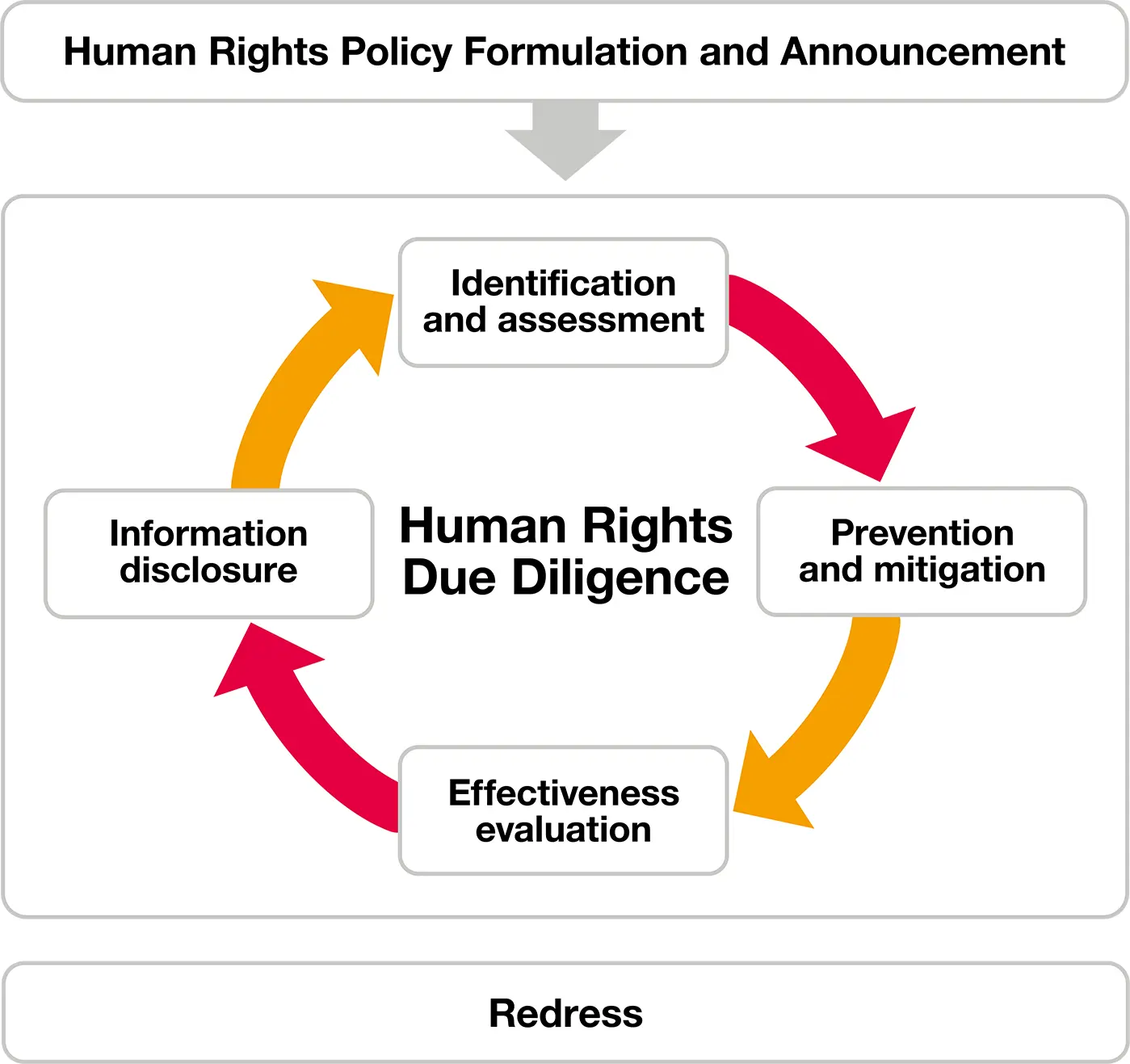
MIXI has established a human rights due diligence process1 that identifies and assesses human rights risks that may arise from the negative impacts of our business activities, and then takes steps to prevent or mitigate the risks, assess the effectiveness of these steps, and disclose information.
1. Process established in accordance with the UN Guiding Principles on Business and Human Rights.
Human Rights Risk Identification and Assessment
MIXI has established a process for identifying and assessing human rights risks, incorporating the expertise of outside experts of international human rights standards, based on the United Nations Guiding Principles on Business and Human Rights (UNGP), the OECD Due Diligence Guidance for Responsible Business Conduct, and the government’s Guidelines on Respecting Human Rights in Responsible Supply Chains.
In addition, we will continuously review the policy while taking into account changes in the business environment.
In the process of identifying and assessing human rights risks, we referred to the ILO Core Labour Standards and the UN Guiding Principles to identify not only risks specific to our company, but also a wide range of human rights issues, including forced labor, child labor, freedom of association, right to collective bargaining, discrimination (gender, LGBTQ+, disability, etc.), freedom of expression, violation of privacy, and non-compliance with occupational health and safety.
For our set assessment targets, we hold dialogues with outside experts and relevant business sections to visualize possible risk scenarios, and then identify and assess human rights risks.
Creating a Human Rights Risk Map
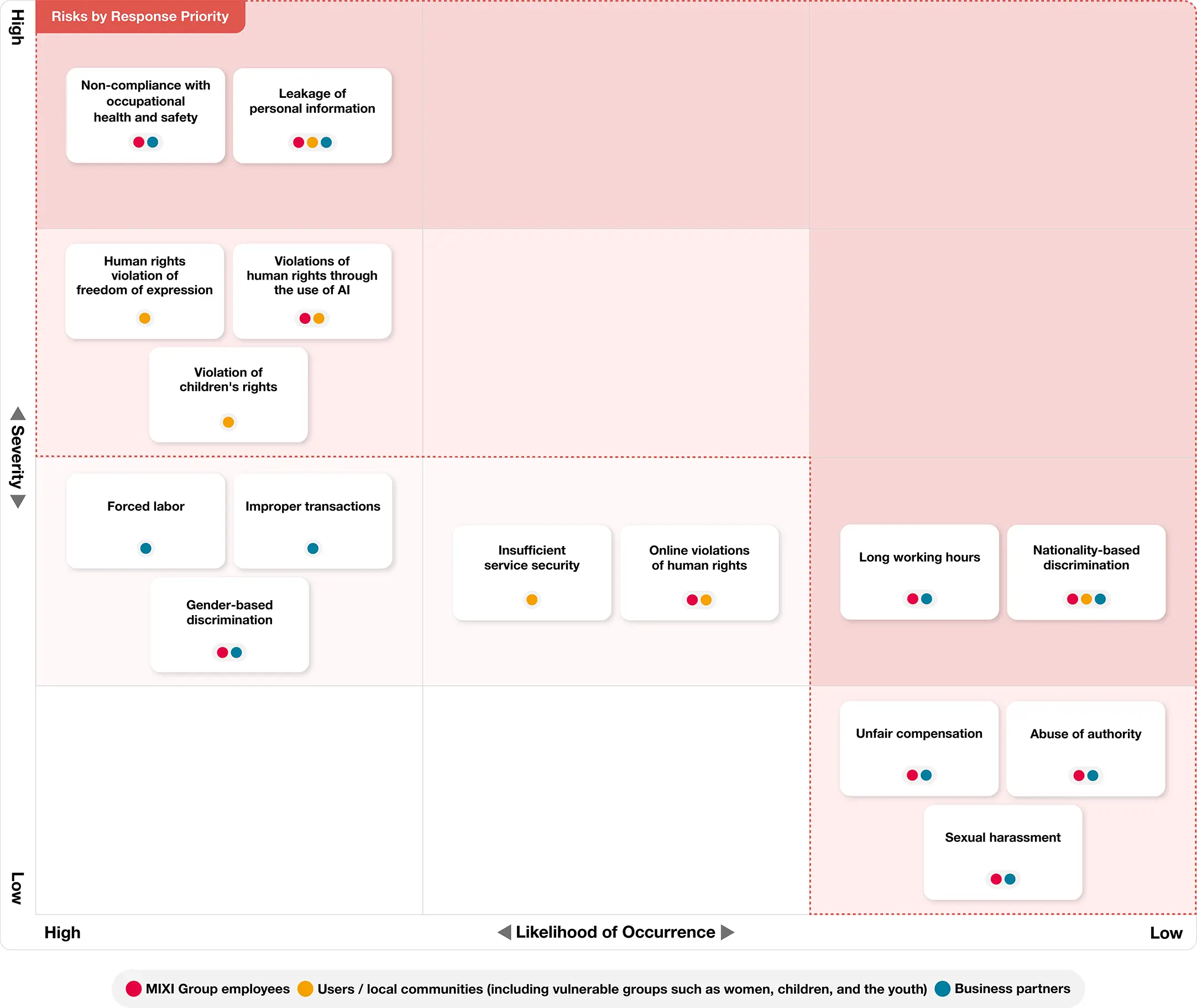
Based on the human rights risk identification and assessment process, we analyze the severity and likelihood of occurrence according to business characteristics and create a human rights risk map tailored to our company.
Our Process
Step
Details
Identification of Key Risks
• Human rights risks are categorized by severity and likelihood of occurrence, assessed for each business, then scored2. We define key risks as risks assessed to have the highest overall scores when using a framework based on the government’s Guidelines on Respecting Human Rights in Responsible Supply Chains.
2. The severity and likelihood of occurrence of risks are assessed and scored using the following criteria.
Severity: Overall assessment of actual and potential impacts from the following four factors
• Scale: Level of negative impact on human rights
• Scope: Spread of negative impact
• Difficulty of redress: Difficulty of restoring the situation to the same level as before the negative impact occurred
• Damage to public trust: Effect on management and business continuity due to negative impact
• Scale: Level of negative impact on human rights
• Scope: Spread of negative impact
• Difficulty of redress: Difficulty of restoring the situation to the same level as before the negative impact occurred
• Damage to public trust: Effect on management and business continuity due to negative impact
Likelihood of Occurrence: Assessment based on actual cases at MIXI or other companies
Creating a Risk Map and Identifying Response Priority
• Identified key risks are placed on a matrix based on their severity and likelihood of occurrence.
• Key risks with particularly high severity and likelihood of occurrence are classified as priority risks with a high response priority.
Human Rights Risk Map
Initiatives for Individual High Response Priority Risks
Human Rights Risk
Our Initiatives
Related Links
All Risks
• Establishment of Business Conduct Guidelines and implementation of company-wide education (e-learning)
Unfair Compensation
• Appropriate management of working hours through an attendance system
• Clarification of role, wage, and benefit differentials by employment status
Long Working Hours
• Orientation for newly appointed managers
• Appropriate management of working hours through an attendance system and individual follow-ups for those who work long hours
Non-compliance With Occupational Health and Safety
• Establishment of health and safety management system and operation of a health committee
• Appropriate management of working hours through an attendance system and individual follow-ups for those who work long hours
• Preparation of manuals for laboratory use and consultation services such as public health nurse consultations and EAP
Nationality-Based Discrimination
• Harassment prevention training (e-learning), and establishment of a consultation service
• Cross-cultural understanding training
Human Rights Violation of Freedom of Expression
• Advance checks for problematic language when creating characters, content, etc.
• Anti-harassment features to social media services, such as blocking, privating, and reporting
Violation of Children’s Rights
• Age-based spending limits (e.g., settings requiring parental consent)
• Monitoring and taking action against inappropriate posts such as child sexual abuse material
• Age-based “zones” based on our terms of use and other regulations to ensure that children can use our services safely
Abuse of Authority
• Implementation of rules to prevent harassment
• Harassment prevention training (e-learning)• Establishment of a harassment consultation service
• Implementation of internal incident prevention training
Sexual Harassment
• Implementation of rules to prevent harassment
• Harassment prevention training (e-learning)• Establishment of a harassment consultation service
• Implementation of internal incident prevention training
Violations of Human Rights Through the Use of AI
• Implementation of guidelines, manuals, and consultation services for the use of various generative AIs
• Establishment of terms of use for social media services that prohibit scraping and other activities by third parties
Leakage of Personal Information
• Establishment of rules, guidelines, and privacy policies
• Establishment of an information security management system including CISO assignment, and implementation of company-wide education (e-learning, etc.)
• Application vulnerability assessment and infrastructure configuration monitoring
• Anti-virus and intrusion detection for PCs, and establishment and operation of internal authentication infrastructure
REDRESS SYSTEMS
MIXI has established a contact point for inquiries about our company and services, and accepts inquiries and consultation from each stakeholder with due consideration for privacy.
In addition, we have established a contact point (internal reporting system) to receive reports and consultations regarding violations of laws and regulations, misconduct, or the threat of such violations at MIXI Group. Under the reporting system, the privacy of the reporter, other concerned parties, as well as the content of the report are kept strictly confidential (anonymous consultation is also possible), and appropriate measures are taken to ensure that the reporter is not subjected to unfair treatment, such as a negative change in their work environment or dismissal.
The inquiry contact point and internal reporting system also accepts reports and consultations on human rights violations such as harassment. If an investigation reveals a negative impact on human rights, we will work to appropriately remediate and redress the situation.