












SUSTAINABILITY
Corporate Governance


Basic Approach to Corporate Governance, Capital Structure, Corporate Profile, and Other Basic Information
1. Basic Approach
We recognize corporate governance as a means for maximizing corporate value. As such, we reorganize our organizational structure when appropriate to accommodate the expansion of our business ventures, to manage profits and losses of each of our businesses, and to further clarify authority and responsibilities. We also focus on further enhancing the capabilities of the Board of Directors (which serves as the Company’s decision-making body), of Audit & Supervisory Board members (hereinafter, “ASB members”) and the Audit & Supervisory Board to monitor directors’ performance of their duties, as well as on improving our internal control systems in order to prevent improprieties in business activities.
To continually increase management transparency and fairness, we appropriately present statutory disclosure documents and actively conduct IR activities using our website and other means.
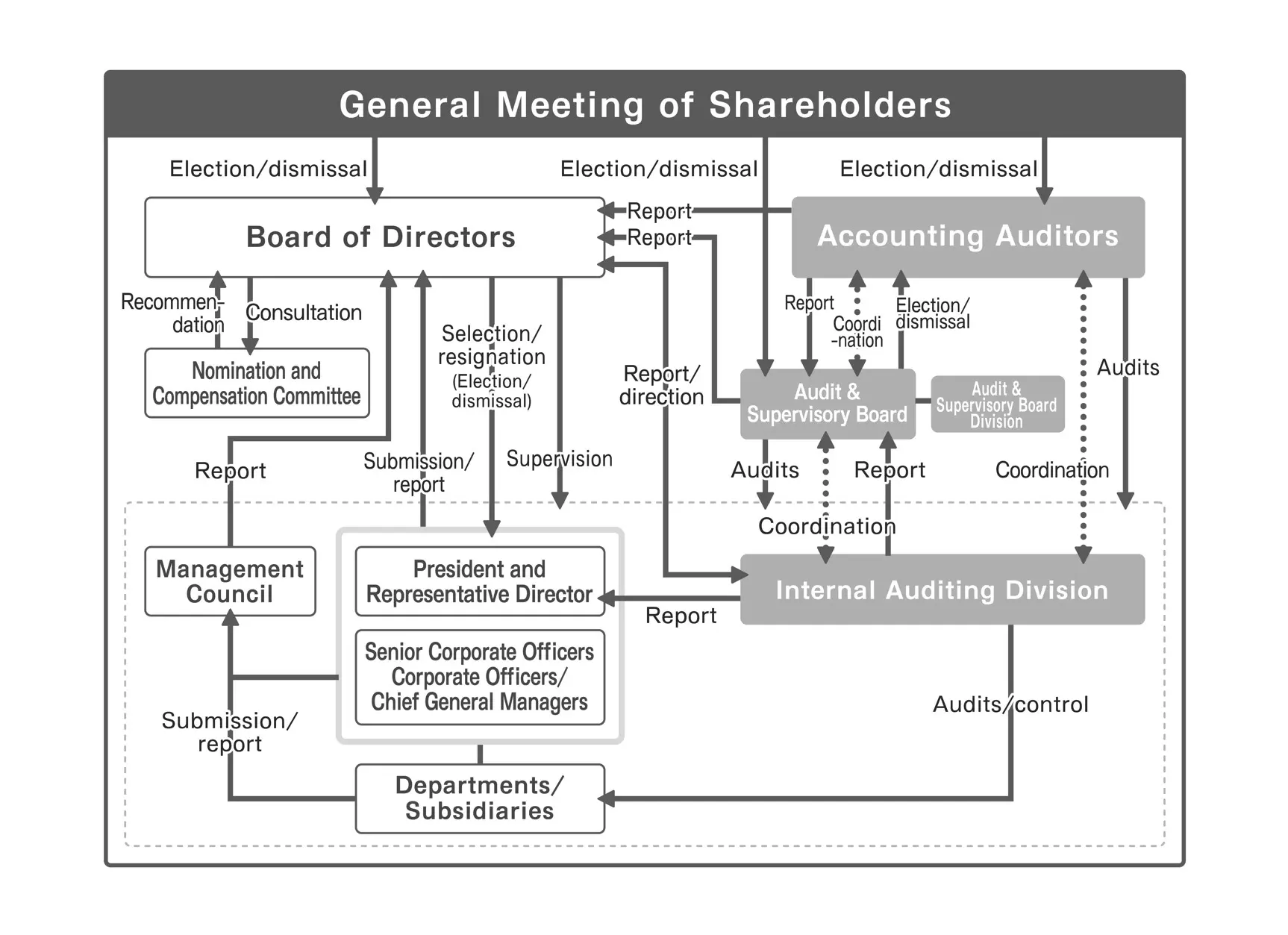
Corporate governance structure
| Organization | Company with Audit & Supervisory Board |
|---|---|
| Number of directors | 7 directors, 3 of whom are outside directors – Outside director ratio: 42% (3 of 7) |
Board of Directors
The Board of Directors has seven members, consisting of four internal directors (currently without female directors) and three outside directors (including one female director). In principle, Board of Directors’ meetings are held once a month, constituting a system that allows speedy and efficient decision-making. For greater clarity of the managerial responsibilities of directors and to create a management system that is able to respond swiftly to changes in the management environment, the term of service for directors is prescribed as one year.
During FY2026, the Board of Directors met 17 times and made decisions on important business execution matters stipulated by law or internal regulations (including the acquisition of treasury shares, the payment of interim dividends, the execution of large-scale M&A transactions, the establishment of business execution systems, revisions to personnel and compensation systems, and amendments to important rules such as the Regulations on Administrative Authority), in addition to conducting discussions based on reports regarding management strategies and the status of business execution. In addition, under the policy of strengthening the strategy- and supervision-related functions of the Board of Directors, discussions were conducted on matters such as the ongoing monitoring of important investments and M&A transactions and their post-acquisition integration status, as well as the development and strengthening of internal control and governance systems in response to the misconduct involving former officers and employees of a subsidiary. Through these efforts, the Board of Directors sought to enhance the effectiveness of its supervisory function. The Board of Directors also regularly monitored the status of communication with investors and the status of sustainability-related initiatives.
Attendance at meetings of the Board of Directors in the fiscal year ended March 31, 2026 was as follows.
https://mixi.co.jp/en/sustainability/materiality/governance/appointment/
Management Council
The Management Council, which is composed primarily of internal directors, conducts key discussions and decision-making related to business operations. In principle, Management Council meetings are held once a week but may be held whenever necessary. Furthermore, necessary information from Management Council meetings is shared with outside officers.
Audit & Supervisory Board
The Audit & Supervisory Board consists of four independent outside ASB members (including two female members). The Audit & Supervisory Board and its members conduct audits based on the annual audit plan in cooperation with internal auditors (personnel or divisions) and accounting auditors. The results and details of these audits are discussed at Audit & Supervisory Board meetings held at least once a month, and appropriate opinions are provided to the Board of Directors or individual directors as necessary to help ensure sound and efficient management.
Nomination and Compensation Committee
We have established a Nomination and Compensation Committee. The objective of the committee is to strengthen transparency and objectivity by obtaining the opinions and advice of outside directors before the Board of Directors deliberates matters related to individual nomination proposals and compensation of directors (excluding outside directors).
The scope of deliberations of the Nomination and Compensation Committee is as follows:
(1) Nominations for and appointments of director candidates along with HR policy proposals
(2) Basic policy proposals for the director compensation system
(3) Compensation condition proposals for directors (including calculation method)
(4) Specific compensation proposals for individual directors (including calculation method)
(5) Other matters requested by the President and Representative Director
Composition of the Nomination and Compensation Committee
Committee Chair (outside director): Akihisa Fujita
Committee Member (outside director): Hiromi Watase
Committee Member (outside director): Toshiaki Kawai
Committee Member (internal director): Koki Kimura
Committee Member (internal director): Kohei Shimamura
During the fiscal year ended March 31, 2026, the Nomination and Compensation Committee met seven times to examine director evaluations, individual director personnel proposals, individual director compensation proposals, and director compensation structure. In addition, they discussed succession plan initiatives.
The Nomination and Compensation Committee for FY2026 was chaired by an independent outside director and consisted of five members, including three outside directors. The attendance of each member was as follows.
| Committee Chair (outside director): Akihisa Fujita | 100% (7/7 meetings) |
| Committee Member (outside director): Hiromi Watase | 100% (7/7 meetings) |
| Committee Member (outside director): Toshiaki Kawai | 100% (5/5 meetings) |
| Committee Member (internal director): Koki Kimura | 100% (7/7 meetings) |
| Committee Member (internal director): Kohei Shimamura | 100% (5/5 meetings) |
(Notes) 1. Figures in parentheses indicate the number of meetings attended divided by the number of meetings held during the term of office. 2. These are the members as of the end of FY2026.
Evaluation of the effectiveness of the Board of Directors
The Company conducts yearly self-evaluation and analysis of the effectiveness of its Board of Directors with the aim of enhancing its capabilities and maximizing corporate value.
Method for evaluating the effectiveness of the Board of Directors
Between January and February 2026, a survey was conducted among all directors and ASB members. We ensured anonymity by having respondents submit their answers directly to an external organization. Based on the aggregated results reported by the external organization, the results of the survey were analyzed, discussed, and evaluated at the Ordinary Board of Directors Meeting held in April 2026.
Survey focus points
– Composition of the Board of Directors
– Management of the Board of Directors
– Management strategies and plans
– Internal controls and risk management
– Director and ASB member support systems
– Evaluation of the Nomination and Compensation Committee
– Discussions with shareholders (investors)
Analysis/evaluation of Board of Directors effectiveness survey results:
The responses to the questionnaire were generally positive and respondents believe that the Board of Directors’ effectiveness as a whole is adequately ensured. Highly evaluated points have been listed below:
- Frequency of board meetings and deliberation time are appropriate, and free, open-minded, and constructive discussions and exchanges of opinions take place.
- The information necessary for directors and ASB members to perform their duties is provided, including well-supported reporting on financial affairs and feedback regarding dialogue with shareholders and investors.
- The Board of Directors appropriately delegates matters where it is deemed suitable to delegate authority to the president / representative director and the Management Council (a body composed mainly of internal directors which conducts meetings related to business execution), ensuring that sufficient time is secured for the deliberations of the Board of Directors.
- The Management Council’s decisions regarding business execution are in accordance with management strategies.
Along with the above points, the evaluation of the Board of Directors saw improved scores overall compared to the previous fiscal year, especially in areas of focus for improvement. Through these improvement efforts, we confirm that the function of the Board of Directors is being properly fulfilled.
Initiatives for improving the effectiveness of the Board of Directors for FY2026:
Based on evaluations of the Board of Directors from the previous fiscal year, the Board of Directors and the Secretariat of the Board of Directors worked on the following initiatives:
- Establishment of an effective information-sharing framework
We established an information-sharing environment integrated with various AI tools, enabling directors to access not only materials submitted for Board meetings but also a wide range of related information. This has created a framework that allows directors to quickly understand the background of agenda items submitted for consideration.
Continuing from the previous fiscal year, each agenda item was deliberated in advance by the Management Council or other bodies. Summaries of those deliberations were shared prior to Board of Directors meetings, and the chairperson explained the key points at the start of each meeting to facilitate more efficient discussions. - Enhance discussion on growth in the medium to long term
We improved reporting on the monitoring of progress toward medium-term management targets by placing greater emphasis on key performance indicators. To improve the quality of management decision-making, we established a quarterly discussion forum separate from Board of Directors meetings. This forum was used to discuss topics that contribute to the Company’s medium- to long-term growth, including the medium-term vision, the enhancement of Group governance, and the future role of the Board of Directors. - Strengthening monitoring for group governance
We enhanced our risk management framework by strengthening Group-wide response systems for misconduct risks. We also promoted greater visibility into the management status of subsidiaries and strengthened oversight functions through measures such as regularly reporting on the progress of PMI at overseas subsidiaries. - Exploring the optimal structure and role of the Board of Directors for the Company
In response to significant changes in the business environment driven by advances in AI technology and the aggressive expansion of overseas operations, we revamped our director and executive structures to accelerate management decision-making and execution. To further strengthen governance, we appointed an independent outside director as chairperson of the Nomination and Compensation Committee, enhancing the objectivity and transparency of its processes. The Committee also overhauled its nomination and evaluation systems by reviewing the qualifications required of directors and introducing peer reviews. In addition, to establish a framework capable of driving sustainable growth in corporate value, we decided to introduce a new compensation system aligned with our medium- to long-term strategy, including the introduction of STI and LTI and an increase in the proportion of variable compensation.
Future initiatives
Going forward, we recognize that enhancing discussions aimed at medium- to long-term growth, strengthening monitoring related to Group governance, and exploring the most appropriate structure and role of the Board of Directors for the Company are important ongoing priorities. In addition, in response to requests for further improvements in the quality and efficiency of Board discussions, we recognize the need to place particular focus on measures that enhance the quality of deliberations by the Board of Directors.
Using the results of this evaluation, we will continue striving to improve the effectiveness of the Board of Directors as a whole.
Peer review of directors
To provide multifaceted feedback on the contributions and competencies of individual directors and to promote greater self-awareness and mutual understanding, we have conducted peer reviews of directors since the fiscal year ended March 2026. Based on the insights gained through these peer reviews, we aim to improve the overall effectiveness of the Board of Directors by more clearly defining the roles and areas of expertise expected of each director.
Other initiatives that complement corporate governance systems
To enhance the effectiveness of the Board of Directors, the Company holds the following voluntary meetings to provide opportunities for discussion and information sharing.
Officer information sharing meetings
In addition to Board of Directors meetings, we have established a discussion forum of outside directors, outside ASB members, internal directors, and senior corporate officers once a quarter for the purpose of sharing information on management strategies and agenda items to be presented to the Board of Directors, which allowed time for in-depth discussions of those agenda items.
Internal control
We are developing our internal structure with the basic policies of our internal control system as its base.
The Group has established our MIXI Group Business Conduct Guidelines and Code of Ethics that emphasize the importance of compliance and ensures that all officers and employees are fully aware of what that entails through an information system, training, and the like. In addition, the Group has established an internal reporting system as a check against activities that are illegal or go against our Articles of Incorporation and to prevent scandals, and has prepared a system to exclude antisocial forces.
For our information management system, we have established rules for information management, clarified denotation for important documents and how they should be stored, and created a system for safely saving and managing personal information, important business secrets, and information regarding director work activities.
Overview of Timely Disclosure System
1. Our stance and policy on timely disclosure
We believe that timely and appropriate disclosure of information to shareholders, investors, local communities, and other stakeholders will promote greater understanding of the Company, allowing proper evaluation of the Company. We are always working to improve our internal systems to ensure that we can disclose corporate information in a timely, accurate, and fair manner from the perspective of our stakeholders.
We also ensure that our officers and employees are educated on subjects such as insider trading and information subject to timely disclosure through internal training programs both when they join the Company and annually.
2. Internal system for the timely disclosure of corporate information
To ensure thorough internal management of corporate information and appropriate and timely disclosures, several specialized sections have been set up under the direction and supervision of the management and company-wide initiatives have been launched. In order to improve the accuracy and content of disclosure materials, we have established a system in which multiple sections mutually check each other’s work while confirming the quality of our internal control system through regular internal audits. We also have auditors regularly conduct quality and legality checks of our accounting information. In addition, the Company’s management and specialized departments have established a system in which they collect and report timely and appropriate information that follows our disclosure guidelines from our subsidiaries, which is then disclosed if deemed necessary.
3. Procedure for timely disclosure
(1) Of information regarding important decisions and occurrences
The senior corporate officer or corporate officer in charge of the department overseeing IR operations works alongside the IR and Legal Affairs sections to analyze information reported by each part of the Company and the Group’s companies. They then follow the rules regarding timely disclosure, determining whether information needs to be disclosed, what exactly to disclose, the method of disclosure, then disclosing the information promptly.
As a result, any important matters determined subject to timely disclosure are reported to the Management Council or President and Representative Director, then presented to the Board of Directors (directly depending on the level of importance), and promptly disclosed upon approval by the Board of Directors.
(2) Of information regarding financial results
The accounting section shall consult with accounting auditors and outside experts as necessary to make a report regarding carefully examined financial results materials for the senior corporate officer or corporate officer in charge of the department overseeing IR operations and, upon approval of Board of Directors, promptly disclose the information.
4. Method of timely disclosure
The Company discloses corporate information without delay via TDnet and EDINET and also distributes disclosure materials to the press. In addition, the Company posts publicly disclosed corporate information on its website and otherwise strives to provide timely, accurate and fair updates to all shareholders and investors.